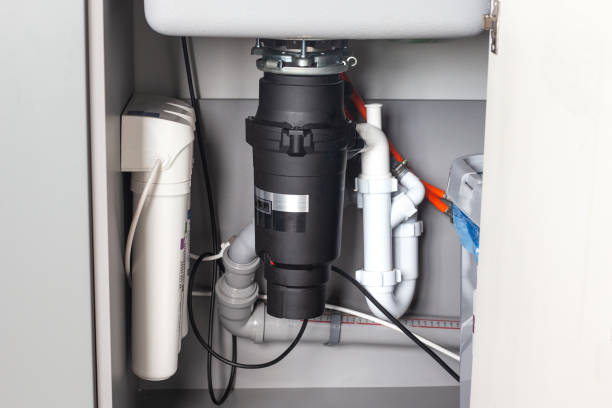
Locating and sealing leaks at the sink flange, discharge pipe, or dishwasher inlet before they damage the cabinet below.
Disposal Leak Repair Overview
A leaking garbage disposal can come from several different points, and the fix is very different depending on which one it is: the sink flange seal at the top, the discharge pipe or P-trap connection, the dishwasher inlet if one is connected, or a worn seal inside the motor housing itself. Left alone, any of these can slowly warp or rot the cabinet floor underneath the sink.
We diagnose the actual leak source with the unit running under water rather than guessing from where the water pools, since water can travel along the housing before dripping. Flange and pipe-connection leaks are usually a straightforward seal or gasket replacement; a leak from the housing itself often means the unit's internal seal has failed, which is a signal to weigh repair against replacement based on the unit's age.
What's Included With Disposal Leak Repair
Leak source diagnosis under running water
Sink flange seal replacement, if that's the source
Discharge pipe and dishwasher inlet resealing
Housing seal assessment for internal leaks
Test run to confirm the leak is fully resolved
How We Handle Disposal Leak Repair
Call or book online
Tell us what's happening — humming, leaking, or dead — and we'll give you a same-day or next-day appointment window.
On-site diagnosis
A technician identifies the actual cause (jam, seal failure, motor fault, wiring issue) before recommending repair vs. replacement.
Upfront pricing
You get a clear price before any work begins — repair or new unit installation, no surprise add-ons after the fact.
Repair or install
Most repairs and standard installations are completed in a single visit, using a properly sized unit when replacement is the better option.
Test and clean up
Every unit is run under water and tested for leaks, noise, and full drainage before we consider the job finished.
Disposal Leak Repair Cost
Most disposal repairs cost less than a full replacement — we'll always tell you honestly which one makes more sense for your unit's age and condition.
Service
Typical Price
What Affects It
Diagnostic visit / minor repair (reset, jam clearing)
$95–$175
Most single-visit repair calls
Seal, gasket, or leak repair
$150–$275
Depends on whether the flange or housing seal needs replacing
Motor or wiring repair
$175–$350
If the unit is repairable rather than needing replacement
Standard disposal installation (customer-supplied unit)
$150–$250
Labor only, existing under-sink plumbing
Full replacement (unit + installation)
$300–$600
Varies by horsepower and whether new wiring or plumbing is needed
Ranges are estimates for typical jobs. Final pricing is confirmed on-site before work begins.
Where Disposal Leak Repair Is Available
We're adding new cities regularly. Disposal Leak Repair is currently available in:
San Antonio's municipal water, drawn from the Edwards Aquifer, runs 15–20 grains per gallon of hardness — among the hardest tap water of any major Texas city, and it takes a real toll on disposal motors.
Houston Heights was founded in 1891, giving Houston a historic housing district where disposal replacements should account for earlier kitchen alterations and existing drainage.
Dallas designated Swiss Avenue as its first local historic district in 1973, highlighting a housing legacy that calls for careful kitchen plumbing assessments.
Fort Worth's Fairmount neighborhood contains a concentration of homes built from 1905 to 1920, making existing kitchen connections an important part of disposal assessments.
Austin Water reported average hardness of 93 parts per million in 2025, a useful reference when investigating mineral deposits and reduced kitchen faucet flow.
El Paso's Sunset Heights received its name in 1901, and its historic homes make kitchen renovation history relevant when assessing disposal leaks or replacement fit.
Arlington's Old Town Historic District covers nearly seven blocks of early homes, where disposal work should consider previous renovations and existing drain connections.
Corpus Christi entered Stage 3 drought restrictions in December 2024, underscoring the value of conserving water without operating a garbage disposal with insufficient flow.
Plano's 2024 water report lists Leonard treatment plant hardness of 112 to 188 parts per million, providing context for checking mineral deposits near kitchen fixtures.
Lubbock's 2023 water quality report recorded hardness of 200 parts per million, making mineral deposits worth checking when kitchen faucet flow becomes restricted.
Laredo's Barrio Azteca retains buildings from the 1870s, making previous kitchen alterations and existing drain fittings important considerations during a garbage disposal replacement.
Irving's Heritage House dates to 1912, illustrating the city's older residential roots alongside Las Colinas development and the need to assess actual disposal connections.
Garland's utility FAQ reports average water hardness of 161 milligrams per liter, a useful reference when investigating deposits and reduced flow at kitchen fixtures.
Frisco's report covering 2024 lists Wylie plant hardness of 105 to 202 parts per million, providing local context for mineral deposits around kitchen fixtures.
McKinney's Faires House dates to 1854, illustrating the city's long residential history and why older kitchen layouts deserve attention during disposal replacement planning.
Grand Prairie annexed Dalworth Park in 1942, adding an established neighborhood where disposal replacement should account for kitchen remodeling and the condition of existing connections.
Amarillo recorded minus 16 degrees Fahrenheit on February 12, 1899, illustrating the severe cold possible when evaluating plumbing exposed to unheated spaces.
Brownsville's Stillman House dates to 1850, reflecting a residential history that makes previous kitchen renovations and existing connections relevant when planning disposal replacement.
Denton's Oak-Hickory district includes early 1900s residences alongside later ranch homes, making the age of actual kitchen fittings more informative than neighborhood age alone.
Killeen Heights subdivisions were platted during the early 1950s, creating an established housing setting where disposal replacement should include inspection of retained kitchen connections.
Mesquite's utility FAQ describes water hardness ranging from 93 to 134 milligrams per liter, providing context for mineral deposits and restricted kitchen fixture flow.
McAllen's Archer Park was donated in 1917, anchoring a historic downtown where kitchen maintenance should protect drainage while making careful use of water.
Pasadena's Sunset Terrace has a reported average construction year of 1950, making retained kitchen fittings and later renovations relevant to disposal repair assessments.
Waco's 2025 water report identifies its drinking supply as 100 percent surface water from Lake Waco, making efficient kitchen water use a practical consideration.
Midland's municipal FAQ reports hardness of 400 to 600 parts per million, making mineral deposits a relevant consideration when evaluating reduced kitchen faucet flow.
Round Rock's 2024 water report lists average hardness of 249 milligrams per liter, providing a dated reference for mineral deposits around kitchen plumbing fixtures.
Why is my garbage disposal leaking from the bottom?
This usually points to a worn seal inside the motor housing rather than a pipe connection — a repair that's worth evaluating against the unit's age, since older units may be better replaced than resealed.
Can a leaking disposal be repaired instead of replaced?
Often yes, especially if the leak is at the sink flange or a pipe connection rather than the housing itself. We'll diagnose the exact source before recommending either option.
Will a garbage disposal leak damage my cabinet?
Yes, over time — standing water under the sink can warp particleboard cabinet flooring and encourage mold. It's worth addressing a leak promptly rather than waiting.
Open 7 Days a Week
Disposal Leak Repair
Call now for same-day or next-day disposal leak repair — upfront pricing, no surprises.